Execution-adjusted risk intelligence

Municipal resilience is only real when it is delivered.

ResilIndex turns fragmented public records, financial data, operational evidence, and geospatial signals into execution-adjusted risk intelligence — revealing residual economic exposure that plans and funding alone do not close.

Cities publish resilience plans, secure grants, and announce infrastructure projects. But a planned or funded project is not the same as functioning protective capacity. ResilIndex helps decision makers see whether resilience commitments have actually progressed into documented operational risk reduction.
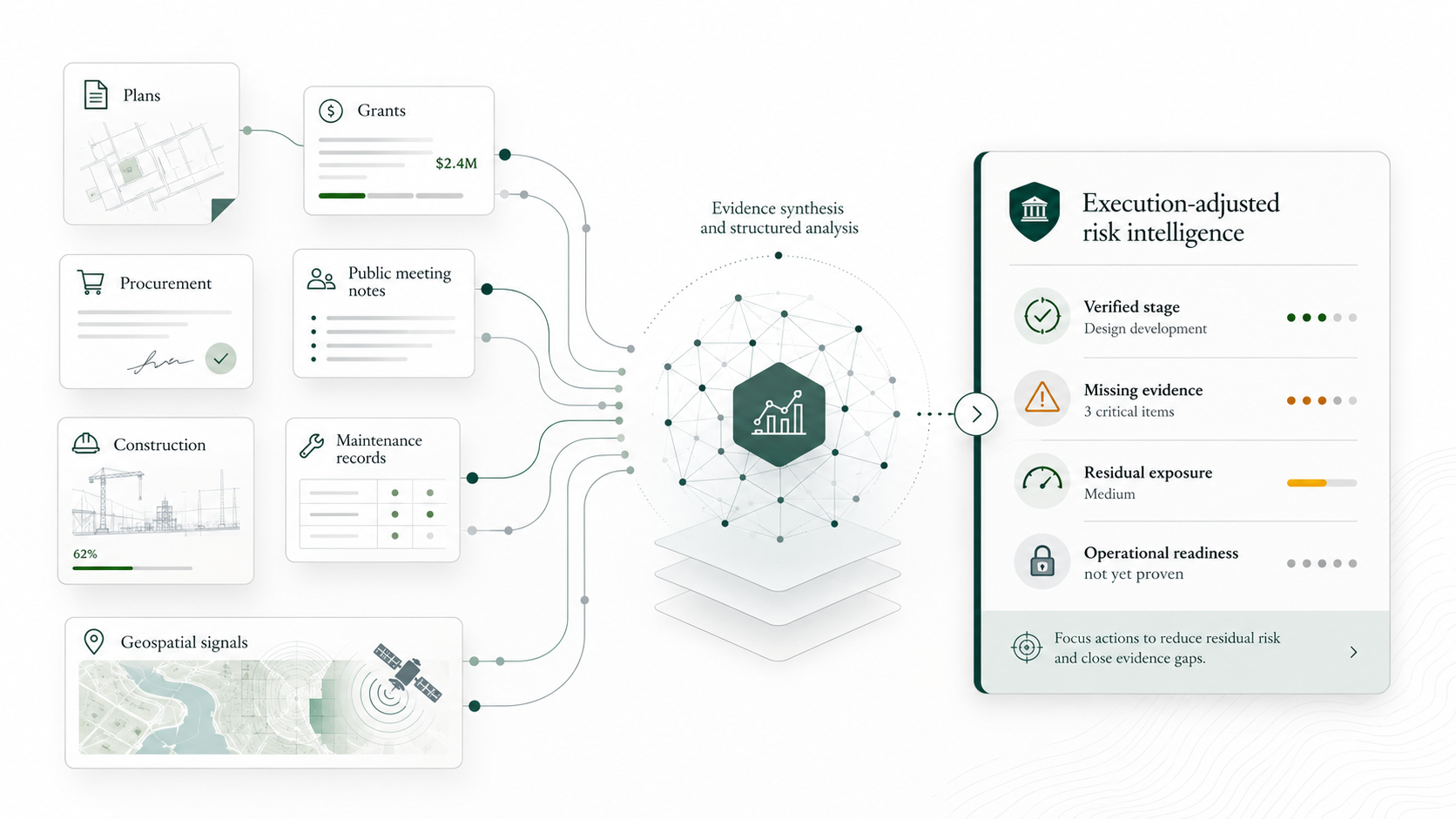
Evidence synthesis: fragmented municipal, financial, operational, and geospatial evidence into execution-adjusted risk intelligence

Risk reduction is often assumed before it is delivered

Traditional municipal risk analysis often focuses on exposure: flood zones, storm surge, wildfire risk, heat, seismic vulnerability, infrastructure condition, or emergency-response needs.

Exposure matters. But it is only one side of the risk picture. The other side is execution. A city may know the risk. It may have a plan. It may have funding. It may even describe a project as “in progress.” Yet the underlying risk may remain materially untreated if the project is delayed, blocked, incomplete, only partially implemented, or lacks documented evidence of operational readiness.

A plan is not delivery
Published plans do not equal completed, operational projects.
A grant is not protection
Funding alone does not reduce physical risk exposure.
An announcement is not operational readiness
Projects described as underway may still leave risk untreated.

What ResilIndex analyzes

ResilIndex connects evidence across source types that are usually fragmented, inconsistent, and difficult to interpret together.

Capital improvement plans
Hazard mitigation and resilience plans
Budgets, grants, and appropriations
Procurement records
Bid documents and contract awards
Notices to proceed
Permits and easements
Construction status updates
Commissioning and closeout records
Maintenance and operational records
Audit findings and public meeting materials
Geospatial and satellite indicators
We transform scattered records into a structured view of what has been planned, funded, contracted, built, verified — and what remains unproven.

From public commitment to operational capability

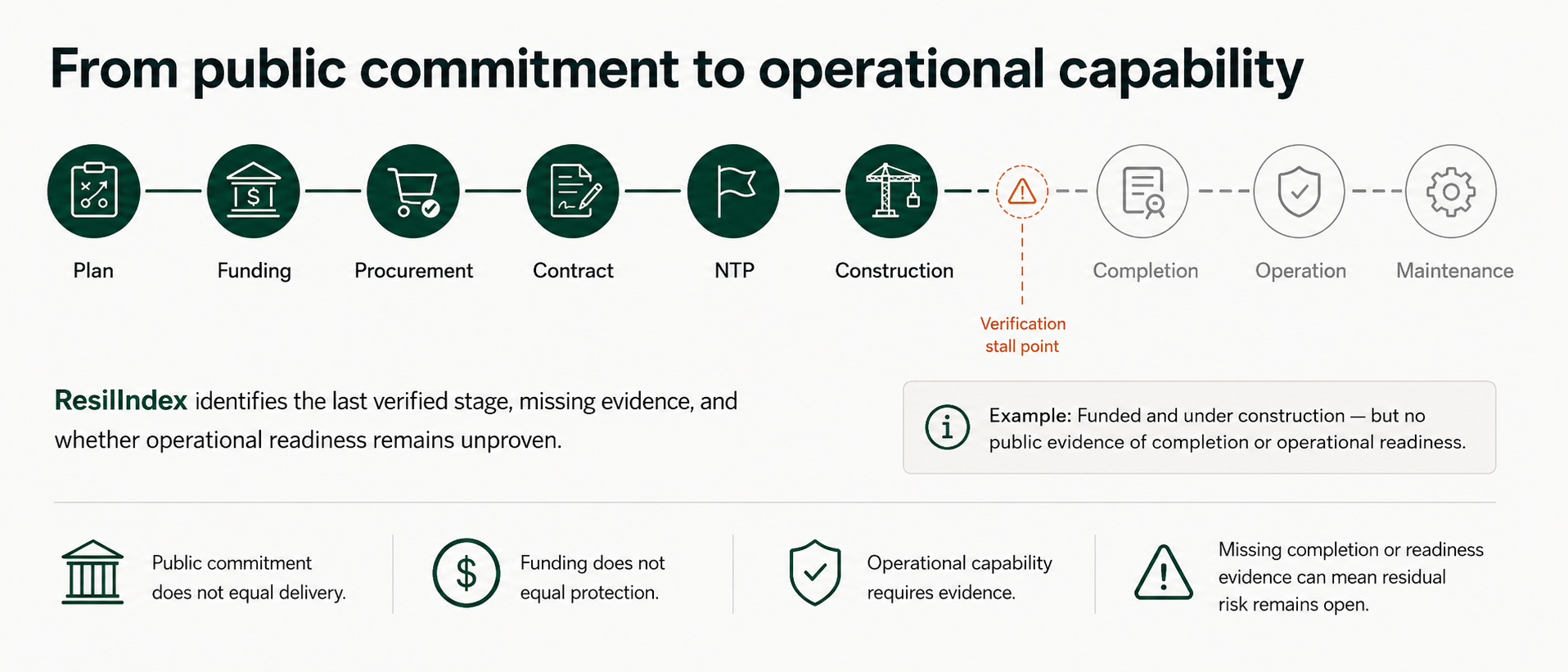
Delivery chain from public commitment to operational capability showing verification stall point and missing operational-readiness evidence

ResilIndex evaluates whether a resilience or emergency-preparedness project has moved through the full delivery chain. We identify the last verified stage, missing evidence, timeline slippage, procurement gaps, unresolved land or permitting constraints, lack of completion evidence, and absence of operational-readiness documentation.

Project-level detail. Portfolio-level insight.

Project-level execution intelligence

At the project level, ResilIndex traces the evidence chain behind specific mitigation and preparedness projects. We assess whether a project has actually reduced the risk it was designed to address — or whether available records show delays, missing approvals, incomplete delivery, or unverified operational readiness.

Portfolio-level municipal execution patterns

Across a municipality’s project portfolio, repeated delays, weak documentation, low grant drawdown, unresolved easements, stalled procurement, or partial implementation can indicate broader execution risk. ResilIndex helps identify whether these project-level gaps create cumulative residual exposure and reveal patterns in municipal delivery capacity.

Same exposure. Same funding. Different execution. Different risk.

Two municipalities can face similar hazards. They can have similar public plans, similar grants, and similar credit profiles. But if one has completed and documented its critical protective projects while the other has not, their real-world residual risk is different.

In a higher-cost, higher-scrutiny environment, timing matters. Project delays can defer expected mitigation benefits, erode the present value of avoided losses, create grant-management pressure, and leave investors, insurers, lenders, and public-sector leaders relying on protection that may not yet exist.

Identify execution gaps
Pinpoint where resilience commitments have stalled or lack documented delivery evidence.
Reveal residual economic exposure
Make visible the risk that remains open despite plans, funding, or public announcements.
Track delivery evidence
Follow each project from initial commitment through documented operational capability.
Support better risk decisions
Equip investors, insurers, and analysts with evidence-based execution intelligence.
Same exposure. Same funding. Different execution. Different real-world risk.

A technology-enabled analyst process — not a black box

ResilIndex uses technology to search, collect, normalize, and compare large volumes of fragmented public information. Analyst review ensures that conclusions remain evidence-based, cautious, and decision-useful. We separate verified facts from inference. We distinguish missing evidence from proven failure. We do not treat grants, announcements, or plans as proof of operational protection.

Source-traceable evidence chains
Every meaningful finding is tied to the underlying document trail.
Evidence-first analysis
Claims are built from records, not assumptions.
Operational readiness focus
Completion is not assumed without documentation of readiness, operation, or maintenance.
Human analyst review
Material conclusions are reviewed by analysts to reduce overclaiming and black-box risk.
Evidence may include council packets, grant records, procurement notices, contracts, audit findings, project status updates, permit records, closeout documents, and maintenance records.

Built for institutions that need to understand real municipal risk

Investors and bondholders

Understand whether municipal resilience commitments have actually reduced exposure, or whether risk remains under-addressed despite plans, funding, or public announcements.

Insurers and underwriters

Assess whether critical mitigation projects have progressed far enough to affect exposure assumptions, underwriting judgment, or monitoring priorities.

Lenders and infrastructure finance teams

Evaluate whether funded public projects are moving toward operational capability or facing delivery friction that may affect local economic resilience.

Credit and risk analysts

Support evidence-based due diligence, surveillance, peer comparison, and residual-risk assessment.

Public-sector leaders and advisors

Identify execution bottlenecks, strengthen documentation, prioritize follow-up, and improve the transition from planning to delivered capability.

When a funded project is not yet protection

A city identifies a flood-mitigation project as critical. The project appears in official plans, receives public funding, and is described as part of the municipality’s resilience strategy. On paper, the risk appears to be addressed.

ResilIndex examines the execution record. We look for procurement activity, contract awards, notices to proceed, permits, easements, construction updates, completion records, commissioning evidence, and maintenance documentation.

If the record shows that the project has stalled, remains dependent on unresolved approvals, lacks construction evidence, or has no public documentation of operational readiness, the conclusion is not that the municipality has necessarily failed. The conclusion is more precise: The available record does not yet show that the funded mitigation commitment has become functioning protective capacity. Therefore, the economic exposure the project was meant to reduce may still remain open.

What ResilIndex delivers

Municipal resilience execution reviews
Project-level evidence chains
Execution-gap assessments
Residual-risk notes
Grant-to-delivery tracking
Procurement and construction status reviews
Operational-readiness assessments
Source registries and claim-evidence tables
Portfolio-level execution pattern analysis
Peer-context scorecards
Monitoring watchlists
Targeted follow-up questions for agencies or municipalities

Each output is designed to show what is known, what is documented, what is missing, and why it matters.

See whether planned resilience has become operational resilience

ResilIndex helps decision makers distinguish between municipal resilience that is planned, funded, or announced — and resilience that has actually progressed into documented protective capability.

Request a Sample Assessment

For details and information: info@resilindex.com